10 Great Dance Movies
(originally published at the now-defunct www.poweredbymovies.com)
I have been quoted as saying, in previous writings, that “there is nothing more exciting, energetic and erotic than a great dance sequence. They get you pumped and feeling alive. They get you to move to the rhythm of life, which is indeed a powerful beat. And if done right, they get you the girl, figuratively speaking (or literally, depending on your circumstances and skills).”
In the spirit of tonight’s first competition week of FOX’s “So You Think You Can Dance,” I give you an assortment of 10 great films (in chronological order) either about dance or heavily featuring the art form.
Film: 42nd Street (1933)
Director: Lloyd Bacon

The mother of all backstage musicals was the first film since the introduction of sound in American films four years earlier to truly show how a movie musical could improve upon one in a live theatre. With dance sequences staged by the master choreographer Busby Berkeley, it paved the way for glorious, overdone and uncompromisingly optimistic rags-to-riches stories for years to come. Look for a pre-Astaire Ginger Rogers as a feisty chorus girl.
Film: Shall We Dance (1937)
Director: Mark Sandrich
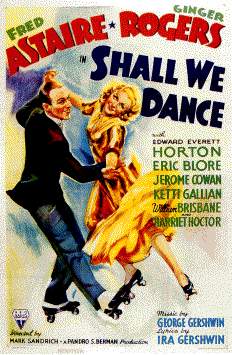 The seventh and greatest teaming of Fred Astaire and Ginger Rogers doesn’t have the cultural impact of “Top Hat,” but it is certainly the freshest movie e’er they shared. He, a famous ballet dancer, falls in love with she, a chanteuse, and while their romance builds slowly, the gossip-hungry world of the socialites fabricate a rumor that the couple are secretly married. Watch not only for Astaire’s “Slap That Bass” number, where he glides around a trans-Atlantic ship’s engine room egged on by the largely African-American crew, but for the show-stopping roller skate number set to “Let’s Call the Whole Thing Off.”
Film: An American in Paris (1951)

Director: Vincente Minnelli
While technically only a musical and mostly unconcerned with dance as a plot point, this Oscar winner for Best Picture nevertheless boasts a climactic 17-minute dance sequence with star Gene Kelly and the grand ensemble, retelling the entire story up to that point in a feverish, frenzied fashion. The sequence cost over half a million (a pretty penny in 1951) and took an entire month to film. While the “Broadway Melody” section of Kelly’s follow-up film “Singin’ in the Rain” is equally as dazzling, it has little to do with the story itself, hence this inclusion of this film over one more beloved.
Film: Invitation to the Dance (1957)
Director: Gene Kelly
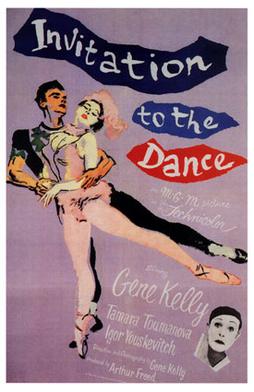
This oft-forgotten masterpiece, about three unrelated stories told entirely through dance and pantomime, was shelved for five years after poor test screening. It’s a pity, because it holds one of the greatest dance sequences in American film history, in which Kelly plays a lovelorn French clown unable to attain his true love. The third part, wherein Kelly interacts with Hanna/Barbera cartoons in a retelling of “Sinbad the Sailor,” is way too silly for its own good, but if you can be like me and find this rare gem on VHS (it is unavailable on DVD) grab a hold of it immediately.
Film: Fame (1980)
Director: Alan Parker

I am unfamiliar with the revered television show, but this Alan Parker film (one of the great modern musical directors who deserves a place among the pantheon of the likes of Stanley Donen, Bob Fosse and Minnelli himself) is an explosion of youthful energy. At a New York high school for the performing arts, angst-ridden teenagers bounce off each other both emotionally and literally, hitting a fever pitch in the title track from Irene Cara. If only all high schools were this expressive.
Film: Xanadu (1980)
Director: Robert Greenwald

Say what you want, but I’m including it. Okay, fine, admittedly it’s a pretty terrible movie on the surface, but the infectious spirit of Olivia Newton-John as a muse sent to Earth in order to inspire Michael Beck to open a roller disco, you could do a lot worse.

Film: Footloose (1984)
Director: Herbert Ross
No list of this sort would be complete without this satire of Middle American values about a town that has banned dancing. Kevin Bacon breaks out and becomes a star in one rollicking central number, and movie trivia games were never the same.
Film: A Chorus Line (1985)
Director: Richard Attenborough
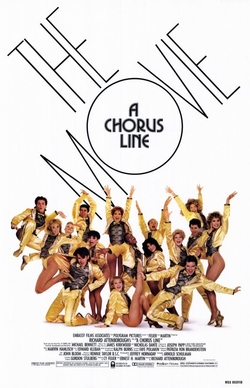 Though widely panned for not being even remotely as good as the seminal stage version (what can be?), this is still in my opinion a heartbreaking ode to the trials and tribulations of being merely part of a Broadway chorus. The film elected to take away the mid-show montage in favor of the terrible (and Oscar-nominated) song “Surprise, Surprise,” but the dancing is still spectacular and Mark’s monologue still hurts me deep within.
Film: Strictly Ballroom (1992)
Director: Baz Luhrmann

Before he was giving epileptic audience members seizures in the madcap musical “Moulin Rouge!”, Luhrmann told a small, sweet story about a competitive ballroom champion and the ugly duckling who loved him. Without too much of the hyperactive camerawork and editing style brought to his later films, he captured the true spirit and energy of perfect dancing I mentioned in the introduction. This is the film where mainstream audiences learned about how the Paso Doble is considered one of the hardest dances to master, information helpful to those who watch “So You Think You Can Dance” religiously.
Film: Center Stage (2000)
Director: Nicholas Hynter
 The guiltiest pleasure of them all, I can tell you without embarrassment that my sister has watched this film at least 25 times. Following a year in the life of New York’s American Ballet Academy” through relationship troubles and professional complications, it’s one of the more accurate portrayals of how difficult the world of professional dance can be. (Robert Altman’s 2003 film “The Company” is, of course, far more accurate, but is needlessly solemn and wooden much of the time.) The final sequence, choreographed by Susan Stroman, is something to behold, as the world of ballet gets flipped on its head and brings in Michael Jackson and Jamiroquai songs.
Labels: Bubsy Berkeley, dance, Fred Astaire, Gene Kelly, So You Think You Can Dance, Stanley Donen
posted by Marcus Gorman at
21:37
|
2 Comments